
Vehicle Trajectory Generator
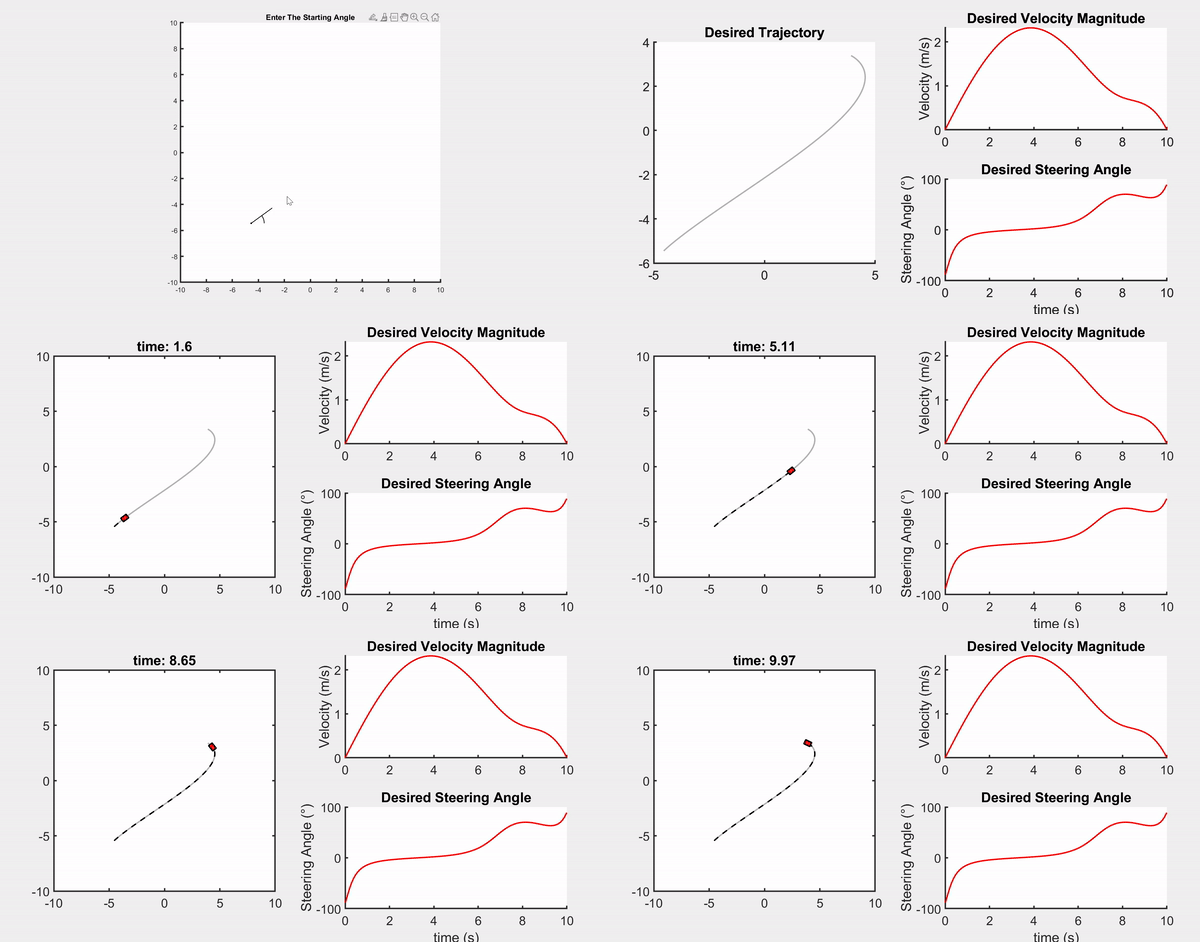
This project was an exercise in trajectory generation. Given a starting and ending state, the model generates a fifth-order polynomial to smoothly drive from start to finish.
The vehicle was designed to begin and end in a stopped state. Additionally, the beginning and ending poses are user-defined. Therefore, it is known a priori that
$$ \dot{x}_0 = \dot{y}_0 = \dot{\theta}_0 = \dot{x}_f = \dot{y}_f = \dot{\theta}_f = 0 $$ $$ x_0 = y_0 = \theta_0 = x_f = y_f = \theta_f = constant $$
We can define the desired positional trajectory as a fifth order polynomial:
$$ x(t) = c_5 t^5 + c_4 t^4 + c_4 t^3 + c_2 t^2 + c_1 t + c_0 $$
From there, the required velocity and accelleration can be written as:
$$ \dot{x}(t) = c_5 5t^4 + c_4 4t^3 + c_3 3t^2 + c_2 2t + c_1 $$
$$ \ddot{x}(t) = c_5 20t^3 + c_4 12t^2 + c_3 6t + c_2 2 $$
If we predefine a target arrival time, $T$, set the initial time as $t=0$, and assemble everything into a matrix, we obtain:
$$ \begin{bmatrix} c_0 \\ c_1 \\ c_2 \\ c_3 \\ c_4 \\ c_5 \end{bmatrix} = \begin{bmatrix} 0 & 0 & 0 & 0 & 0 & 1 \\ 0 & 0 & 0 & 0 & 1 & 0 \\ 0 & 0 & 0 & 2 & 0 & 0 \\ T^5 & T^4 & T^3 & T^2 & T & 1 \\ 5T^4 & 4T^3 & 3T^2 & 2T & 1 & 0 \\ 20T^3 & 12T^2 & 6T & 2 & 0 & 0 \end{bmatrix} \begin{bmatrix} x_0 \\ \dot{x}_0 \\ \ddot{x}_0 \\ x_f \\ \dot{x}_f \\ \ddot{x}_f \end{bmatrix} $$
Here, the output vector contains the coefficients required to generate the desired positional trajectory polynomial. The exact same process is applied in the $y$-direction. Finally, $\theta$ is computed using the kinematic relationship between linear and angular velocity for the bicycle model:
$$ \theta = \operatorname{atan2}(\dot{y}, \dot{x}) $$ $$ \dot{\theta} = \frac{1}{\left(\left(\frac{\dot{y}}{\dot{x}}\right)^2 + 1\right)} \cdot \frac{\dot{x} \cdot \ddot{y} - \dot{y} \cdot \ddot{x}}{\dot{x}^2} $$
With that, the full state trajectory is computed:
$$ X(t) = \begin{bmatrix} x(t) \\ y(t) \\ \theta(t) \\ \dot{x}(t) \\ \dot{y}(t) \\ \dot{\theta}(t) \end{bmatrix} $$